I started this blog to share some of the thoughts I have along the journey of life. I love to travel and spend time with my family and friends. A good meal, breaking bread with those I love, gives my life meaning. So does travel. I adore dreaming of sites to visit, not just to check them off on a list. Rather, I consider myself a student of life, traveling as an explorer, to open my mind to all the possibilities the world holds in store for me and for others. I love to travel to discover how different the world is in terms of climate, cultures, politics, terrain, economy, etc. but also to discover how SIMILAR the people are. Despite language barriers, much can be communicated with a smile or gestures. Language is simply a means to communicate, yet there are so very many other ways to communicate. Once when I was in French-speaking Canada, I realized that my 7th grade French class didn’t teach me the word for “straw”. However, when I thought about it, I was able to communicate to the very French-speaking waiter in a very French-speaking restaurant about my need for a “cylinder through which to drink” in my limited French vocabulary. Travel challenges the mind and soul, stretching us to problem solve and form conclusions about all that we experience. THAT is the type of travel I enjoy best. “All’s well that ends well”, as they say………….”Life is Good” as well.
Author: carpediemcaye
I am a married mother of one teenage girl, a vegetarian, and love to travel. Among my travel bucket list items are to visit all 50 states in the USA, to go to Egypt and the Holy Lands, Antarctica, and to go to Greece. I have been to Germany, Greenland, Canada, Mexico, Tahiti, Bora Bora, Italy, England, Scotland, Holland, France, Bermuda, the Carribean, the Bahamas, Hawaii, the Arctic Circle and have traveled by RV across the country in the US. I also love to raise butterflies.
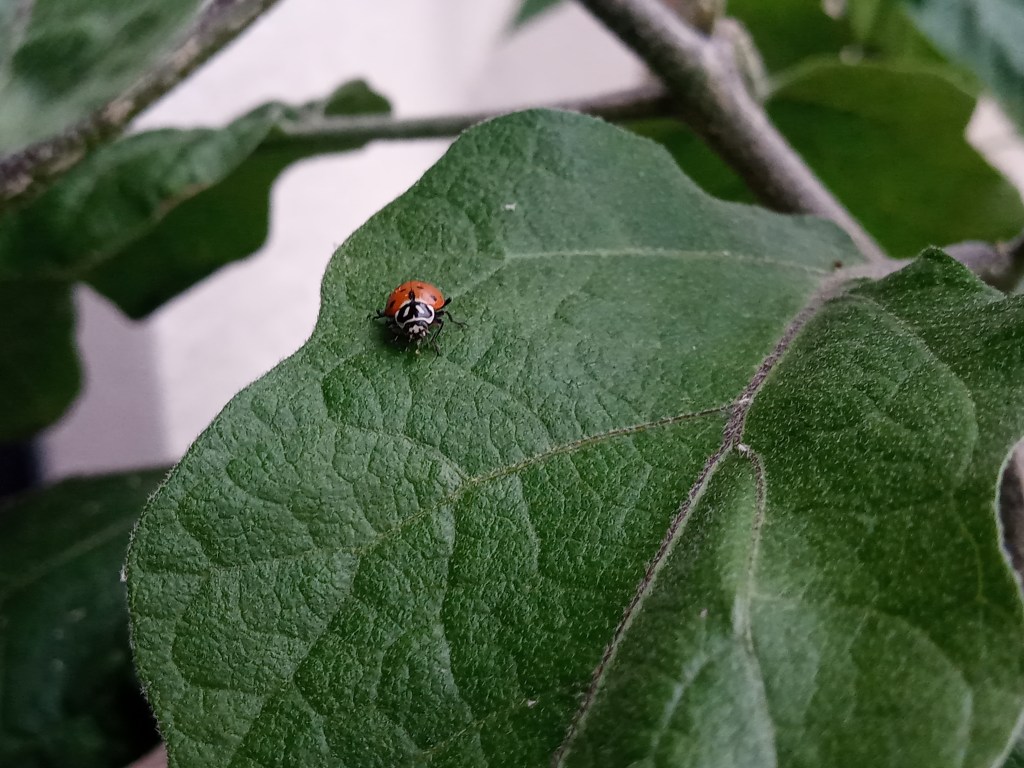
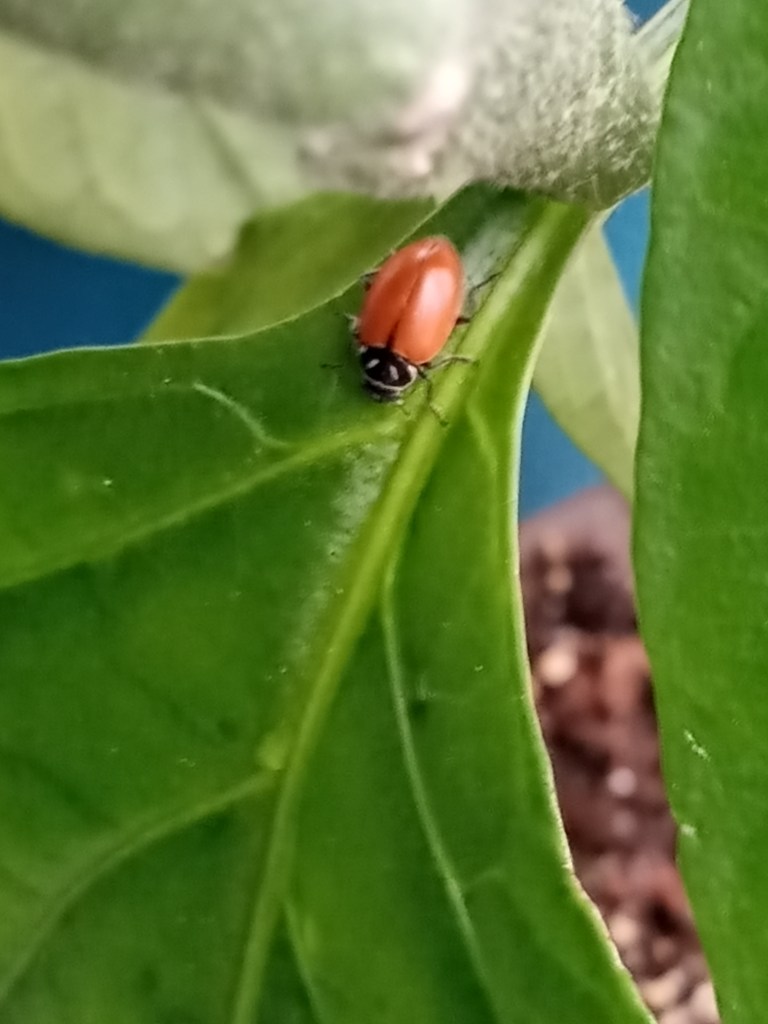
We ordered 1500 live ladybugs to release in our yard recently, as we wanted to find a natural control to the aphids that were eating our plants. They arrived in a small mesh bag, and we released them at dusk one night, as they normally fly during the day. Releasing them at dusk allows them some time to find food and settle in for the night. We sprayed them with a little sugar water as we released them, as this makes their wings a bit sticky for a few days to encourage them to stick around and find food before they can fly away.
We transferred the ladybugs one by one to our plants in the yard and were fascinated by them in the meantime. Who knew watching a ladybug would be such a delight! Some ladybugs don’t have any spots.
“A multitude of small delights constitute happiness.”
-Charles Beaudelaire
Life is good; look for the little things that provide you with a new sense of wonder.
As you may recall, I purchased some Painted Lady caterpillars a while back as a diversion during the state “safer at home” orders during the pandemic. The caterpillars arrived along with their “muck in a cup” (or pre-made food).
After about ten to twelve days, the caterpillars crawled to the top of the cup in which they arrived and started to form the tell-tale sign that they were about to form pupae. The tell-tale sign that signals the beginning of this stage is seen when the caterpillars begin to look like the letter J, as they prepare to bundle up to make a case which is attached to the cup lid by a silk pad they have fabricated. After about twenty-four hours of hanging upside down, the caterpillar skin splits off and exposes a case or pupa.
Seven to ten days later, the painted lady breaks free from its pupa and metamorphisis has been completed. During this stage, the adult structures are formed, and finally the pupa has now turned into a butterfly that needs to dry his wings before he can fly.
Wings dry and harden after about twenty-four hours, and the butterfly continues his life for about two weeks during which the butterfly can travel up to one hundred miles a day at thirty miles per hour. The butterflies can mate around five to seven days after emerging from the cocoon, and the female can lay as many as approximately five hundred eggs in their short life time. Eggs are singly laid on a host plant, such as thistle, mallows, hollyhock, legumes, and others. Once the butterfly reaches the adult stage, their diet includes many nectar plants, such as blazing star, cosmos, New England aster, Joe-pye weed, Mexican sunflower, purple coneflower, and zinnias. They will visit other nectar plants, though, including red clover and milkweed, too.
In our home, when we woke up one morning to find that the first one of our pupae had hatched into a butterfly, there was a great deal of red exudate on the side of the net cage. This exudate is not blood, as many people think, but is meconium, which is waste products of their metamorphic activity.
Shortly after, a second butterfly emerged before we knew it, about a half hour later. We decided to watch the remaining pupae and actually had the good fortune of actually seeing a butterfly emerge from its pupa stage. It was a magic moment, watching life literally unfold before our eyes.
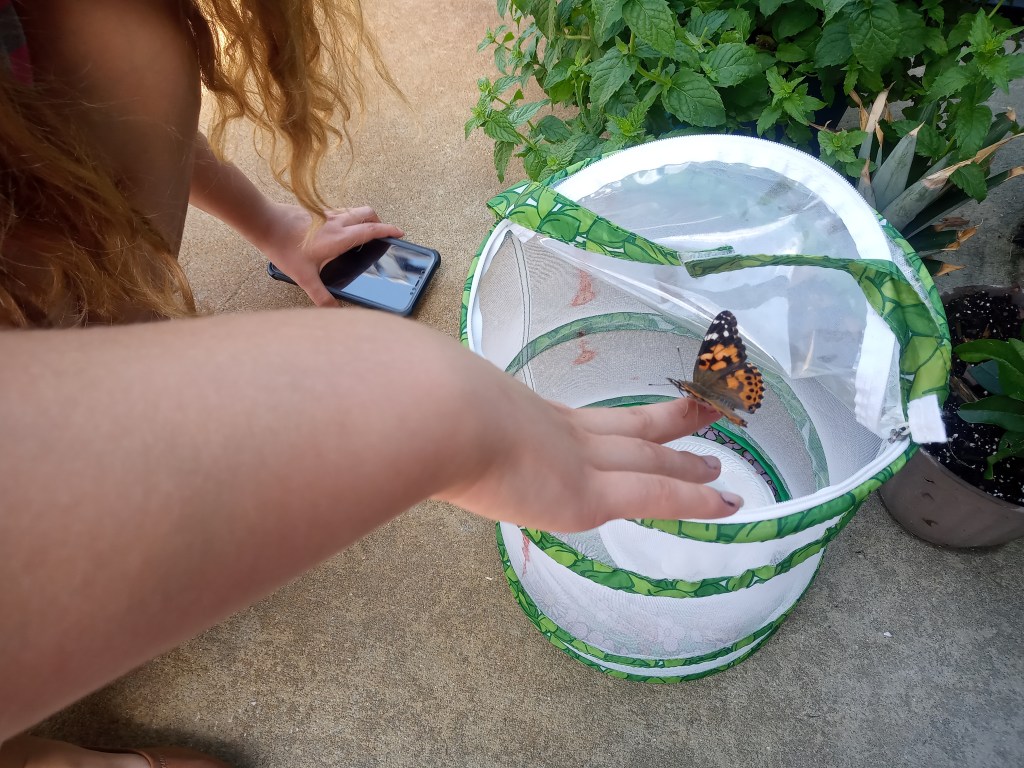
After giving the painted ladies some orange slices and sugar water on a cotton ball on dish in their cage, we decided to let them go free. It was yet another magic moment for us, as my daughter reached inside their cage, and the each butterfly crawled onto her hand in order to be released.
“Always be on the lookout for the presence of wonder.” -E.B. White
If you are interested in raising butterflies, I would recommend you order a kit with pre-mixed painted lady food to start (“the muck in a cup”). Now that we’ve gotten the butterfly “bug”, we plan to raise butterflies from eggs to caterpillars, then caterpillars to pupae, then pupae to adult butterflies. Each type of butterfly needs a certain host plant to lay eggs upon, but there are often many nectar plants that they will eat from as adults.
Three valuable sources of information and supplies can be found at:
butterflydans.com
shadyoakbutterflyfarm.com
butterflyworkx.com
We have been busy gathering a few host plants and many nectar plants for containers around our yard and likely will try malachite butterfly eggs next.
” And above all, watch with glittering eyes the whole world around you because the greatest secrets are always hidden in the most unlikely places. Those who don’t believe in magic will never find it.”
–Roald Dahl
Life is good; find something new in some hidden spot that excites you. Carpe diem, friends………
I am always of the mindset that if we don’t like whatever situation we are in, or if we can’t change the situation, we must change our thinking. Changing our thinking puts our life back into our own hands and allows us a choice as to how we proceed. Self- isolating was (and is still) difficult while we cope with the pandemic, so I began to think of all the wonderful ways I could connect with others beyond my narrow little world in the last few months. I really enjoy reading, so I found an on-line book club which met weekly during the pandemic. Although I didn’t love the books we read, it was such a welcome break to speak with others on-line about a shared experience. Talk centered around the book, but also drifted from time to time to how everyone was feeling about the pandemic. Talk continued also about what our experiences were like, which stores were opening, what restaurants were closed, etc…as the United States began to re-open in the last month or so.
The link below contains a small list of on-line book clubs for avid readers that want a shared experience or wish to try something new:
I have found it helpful in my life to exercise my body, to exercise my mind, and to exercise my soul regularly to stay healthy and well, and during this pandemic it was no different.
Life is good; try out something new today to help you cope with the trials and tribulations of the pandemic. That’s been the beauty of the pandemic, if there is any. That is, we all have found new ways to re-connect with others and to what we may have enjoyed in the past. Find a way to change your thinking and come up with a new diversion, too.
Carpe diem, friends……..
(If you belong to an on-line book club, feel free to message me, and I’ll post a link for others to hear about it, too.)
I am not the first person to draw parallels from the type of ice cream one eats and one’s personality. On the surface, it seems quite easy to say that if one likes to try different varieties of ice cream, one has a more adventurous spirit, while if one prefers the same type of ice cream every time, one is more of a play-it-safe kind of person.
What about the person that tries different flavors but within a narrow range? Maybe this person is adventurous to a point but knows what they like and how to get it. Or perhaps they are a bit grounded, knowing it is not worth the extra time or money to get an ice cream flavor they don’t like. Perhaps these people are goal-oriented, detailed people, instead of play-it-safe kind of people. Pragmatic souls.
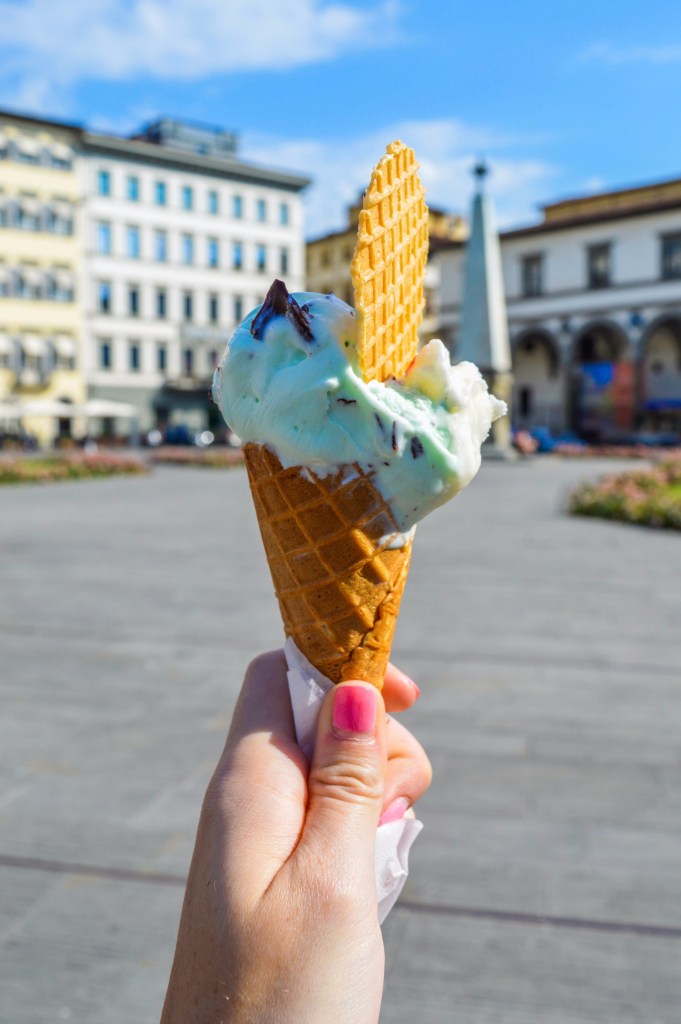
I prefer vanilla. That being said, I don’t like just ANY vanilla. In fact, some vanilla ice creams are not worth the effort it requires to eat in my opinion. And don’t get me started on that gelato stuff. I have traveled extensively in Europe to search for the best gelato, but I find it entirely too light, too airy, and not nearly enough butterfat. The butterfat content, in my opinion, is the essence of the ice cream experience. The higher the butterfat content, the better the experience. My father actually used to eat ice milk (daily) because his cholesterol levels were a bit high, but he wasn’t willing to forego the ice cream (and I use that term loosely) experience, but I can’t forego the butterfat.
Ice cream lives in my blood. Both my parents adored ice cream, and so do I. I once traveled three hours over two state lines when I was a young adult to find the perfect ice cream according to some reviews. There is nothing in my mind better than a road trip, and a road trip involving ice cream would be wonderful, I thought. I always enjoy a large cone of ice cream, as tomorrow will be a day of salad if necessary. Today is about the QUANTITY and TYPE of cool happiness. Today is the day to seize the day.
I have been striving for the perfect homemade vanilla ice cream recipe since lock-down during the epidemic. I prefer my vanilla to be a clear, pure flavor. I like the vanilla to speak for itself. I have even made vanilla from the “Ben and Jerry’s” recipe book, but somehow the vanilla tastes more like a flavored whipped cream to me . I have tried Tahitian Vanilla, as I notice a HUGE difference in vanilla flavors depending on the brand, but to me Tahitian Vanilla tastes too much like soap. If you’ve had it, you might know what I mean. Years ago, I was able to find “heavy” cream” for my recipes but lately all I can find here in Florida is “heavy whipped cream.” Maybe the supplier in New England that I used (good ol’ Stop and Shop) has more variety of creams than my current Florida market. Yes, I guess in the end, I am a “vanilla” kind of gal, with a little chocolate or chocolate chip if I feel REALLY adventurous. And not that mint chocolate chip, either. JUST chocolate chip.
In Florida, Brewster’s Ice Cream in Palm Bay and Kilwin’s in Vero Beach are worth the drive if you are up for a road trip for excellent ice cream. Just don’t try the shakes at Brewsters, as the quality control varies and the taste and consistency is different depending on who makes the shakes.
Life is short. Enjoy that smoothe and cool taste of happiness whenever you can. Try a little chocolate chip from time too time, too; everyone needs a bit of adventure.
Carpe diem, friends………
(And feel free to send me your favorite vanilla ice cream recipe if you want!) I will publish my favorite submission here on my blog).
I have come to many realizations while being cooped up inside during this pandemic. My fascination with one’s perception has me asking myself which is more important in life? The journey or the destination? This is a hot topic among many people, whether they think about it or not. If you think of the people you know, there are many people that are more “journey” type people, yet others are more “destination” people. This fascinates me to no end. Our perceptions about the world colors our approach to living time and time again.
Recently, the discussion in our home has centered around the pergola that my husband built recently in the back yard. We talk about how we are planning on growing all kinds of plants in containers to make the space more inviting when we sit under it. I have enjoyed the many “pipedreams” that have gone round and round in my head, much like I enjoy a good road trip. For me, the journey is such an important part of the experience. Thinking about doing something, pondering about all the possibilities, brainstorming for new ideas, “seeing” the plants in my head in various combinations all give me joy. Similarly it doesn’t matter where I plan to “go” on the road trip; doing whatever comes along, stopping where the wind blows is equally fun. The trip itself, or the journey, is half the fun. It is similar to the selection of planting materials, containers, etc. in my mind. It matters less what I actually plant, as the journey is part of the experience with growing plants as well as I search for “thrillers, fillers, and spillers” for my containers. The pandemic has inspired me to get back to my “roots” of gardening, if only in containers, which is something that had always defined me until I moved to Florida. Gardening here is a whole new world, one that I had not ventured into again until recently.
zinnia, lantana, and calibrachoa
It is very interesting to me that my daughter, “Teen Traveler” isn’t always quite like me. She isn’t always quite like her father, either. However, she’s game for almost anything, like both of us, and I dragged her to a garden center today where we could be in the open and socially distance ourselves with a wide area away from others. I told her I could use her thoughts about what we grow near the pergola and told her that my only requirement was that the plants need to attract butterflies and be colorful. We walked round and round in the garden center, and after a while she announced that she was “done” with the experience as she was getting very hot in the Florida morning sun. She laughed when she said “I guess it really doesn’t matter to me what we plant in the containers. It will be fun, but all I really care is that they look good in the end.” What a revelation. Definitely a “destination” person, at least in this matter. Fascinating.
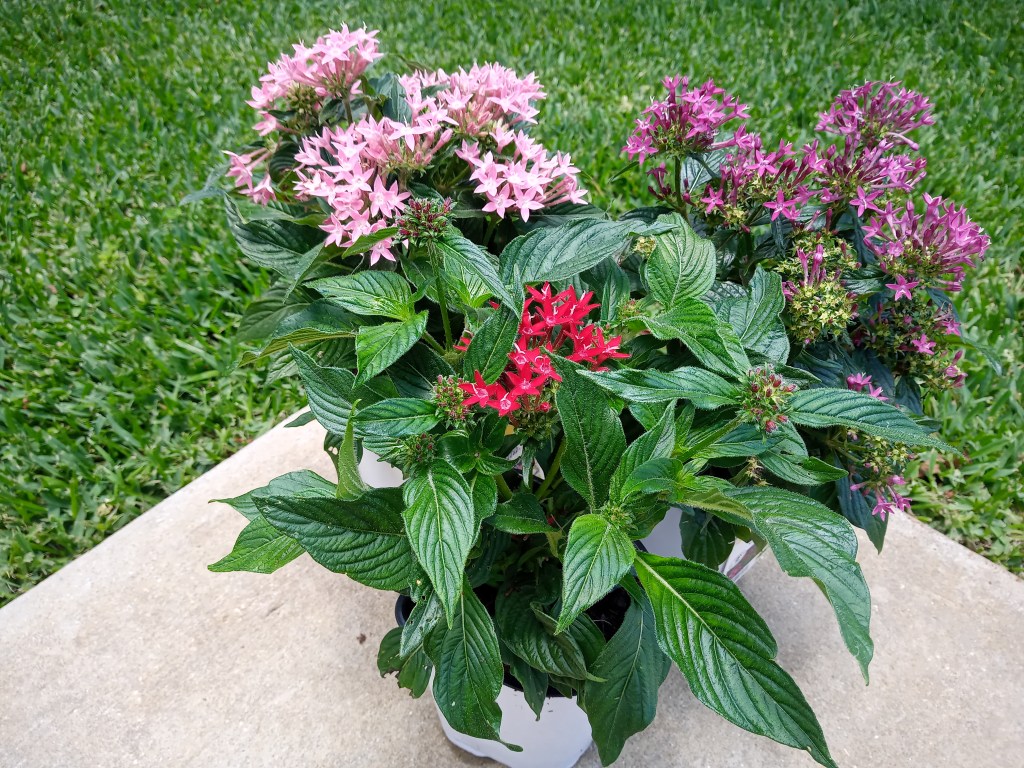
pentas (I am not a big fan or red in the garden, but it sure does attract butterflies)
I guess in the end, I have decided mostly that I want it ALL. I always want it all. The “journey” is part of the joy in my life, as well as the “destination”, too. I always enjoy a good “pipedream” as often as I can as well as having my hands elbow deep in the dirt, but the finished product gives me a sense of satisfaction and joy, too. I wonder if this approach is situation specific or if this approach can be generalized to other areas of our lives as well. Food for thought.
Life is good; enjoy both your journey as well as your destination if you can, whenever you can.
Carpe diem, friends…………………
Two links for creating beautiful container gardens:
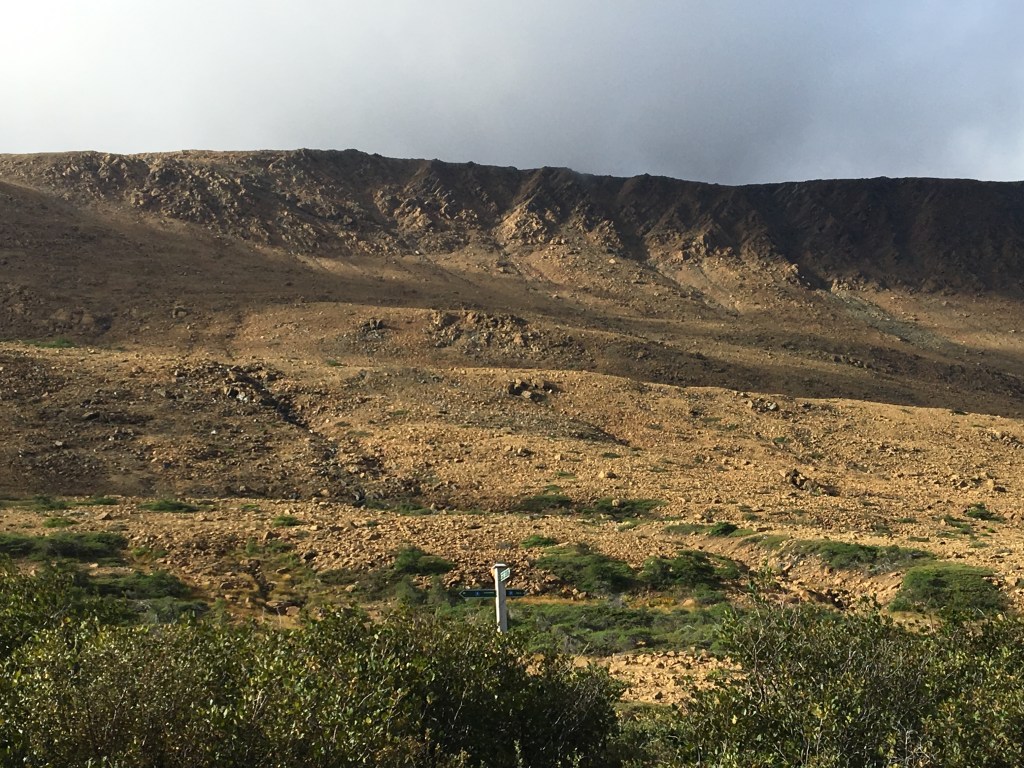
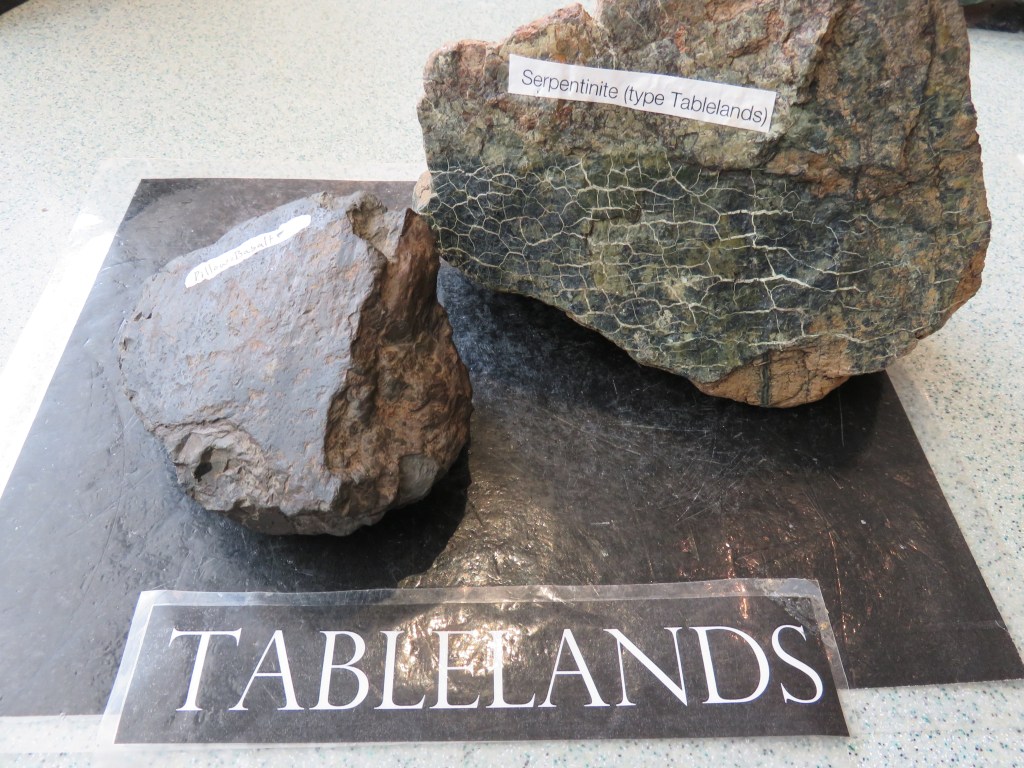
The Tablelands in Gros Morne National Park in Canada, a UNESCO World Heritage Site, has been used as a training site for some NASA astronauts to train for missions to Mars and to the Moon. With the historic Dragon rocket launch yesterday at Kennedy Space Center in Florida with the first commercial space flight in history, launched with the first Americans on American soil in an American rocket in many years, I am thinking of my trip to this wonderful place a few years ago.
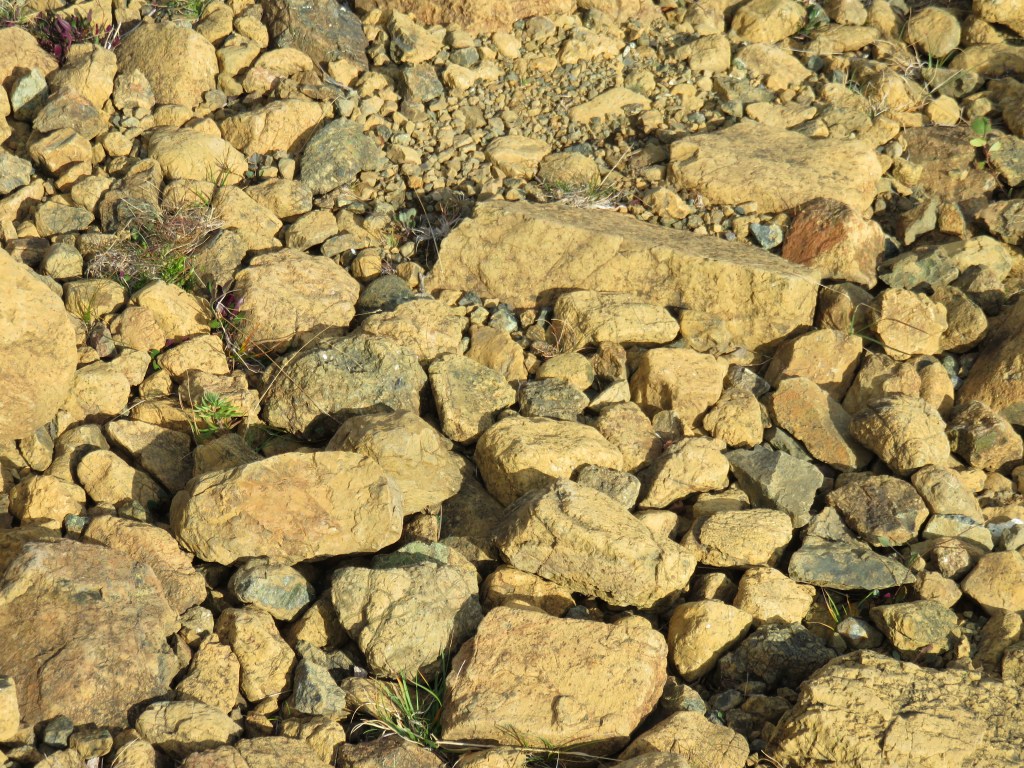
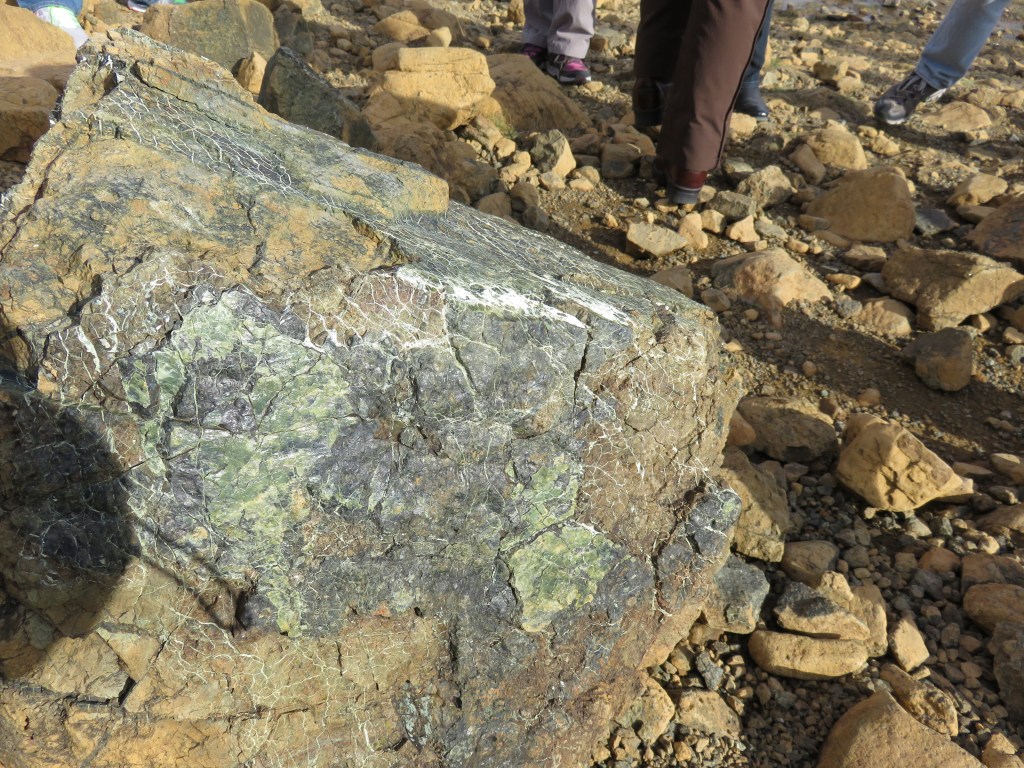
At this wonderful national park in Rocky Harbor, New Foundland, Canada, I walked along a section of orange rocks from the Earth’s Mantle, a layer of rock found normally deep beneath the Earth’s Crust that has been exposed to the surface of the Earth.
layers of the Earth diagram courtesy of Oregon State University
The Mantle is the layer just before the Earth’s outer core. How exciting it was to walk in the place where geologists proved the theory of Plate Tectonics, or the movement and collision of seven large “plates” (and several smaller “plates” of geological material), leading to the creation of geologic events such as earthquakes and volcanoes, as well as the many other processes that form, transform, and destroy rocks.
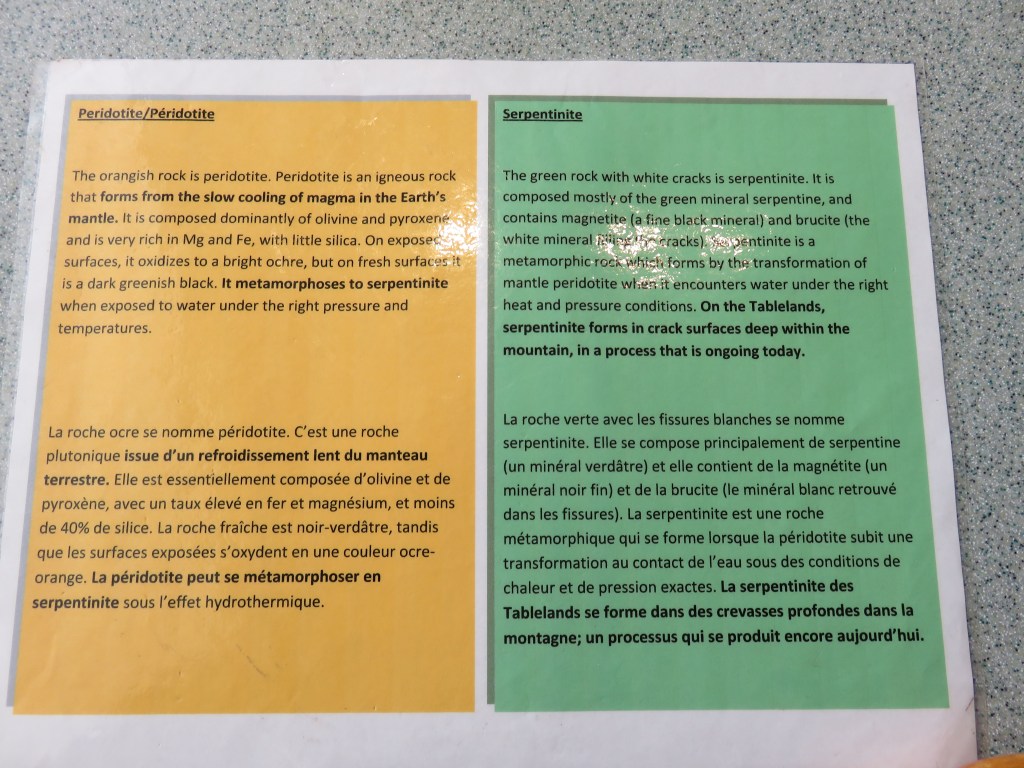
Most of the area at the Tablelands is made up of the rock peridotite, which is part of the Earth’s Mantle that was brought to the surface of the Earth by a large plate collision several hundreds of millions of years ago.
You may recognize the gem peridot, which is crystallized olivine. Olivine is the greenish area contained in the rock peridotite.
photo courtesy of gemkids.gia.edu
If you are a rock or geology lover, this is a great place to visit. I visited in September, which was cool but not too cold to hike. Click on the link below to find out the best way for you to get to the park:
If you are not a lover of geology, perhaps seeing fauna such as moose, woodland caribou, rock ptarmigan, arctic hare, boreal chickadee, Canada jay, or Newfoundland martins might interest you. If you’re not a big animal lover, perhaps some of the flora tucked in between the orange rock setting will interest you as well.
This place was an amazing place to visit, and I highly recommend it. In fact, two movies were even filmed at this park. If you recognize the setting, “Contact” (1997) with Jodie Foster and “Outlander” (2008) with Jim Caviezel were both filmed here.
Life is good. Travel as much as you can when the travel restrictions are lifted after the pandemic is under control. There is a whole wide world outside your window if you look for it.
I am always fascinated with the themes of perception and reality, ignorance and truth. In fact, when I was a young girl, I noticed some numbers adjacent to the inside door, close to the check out counter, in our local convenience store. These numbers were arranged in color-coded blocks, similar to those near the exit door at Lowes. I asked one of my parents about these brightly colored numbers, and one of my parents described that they were there to help identify the heights of any thieves that tried to steal from the store. The numbers represented the heights of the suspects, and the colors were designed to help the store clerk remember the numbers. Fascinating, especially to an older, inquisitive child. This really left an impression on me.
These numbers allowed me to see that everyone sees and remembers things differently. Our conception of reality is based on what we know or have seen, our personal biases, and our interpretations of what we’ve experienced. Fast forward to when I was young adult. Someone very dear to me and I went into a local field to fly a kite, believe it or not. College exams were over, and we were looking for a way to fly a kite as a way to unwind as I recall (based on my perception from many years ago, of course). We were laughing and joking, making a lot of noise, when out of the corner of our eye, we saw someone laying face down in the ground. Surely the person would have roused if asleep we thought. As we walked closer, we realized the person did not move at all, and the person’s calf was exposed and a bit mottled. We touched the person’s calf, seeking a pulse, when we realized the calf was cold. Stone cold. We looked at each other and came to the same realization at once. The person before us was dead. This was long before the days of the ubiquity of cell phones, so we RAN to call the police. Police arrived, and so did the local news reporters. I put my hood up, as it was cold in New England that day, the day we grew up, and I knew we would be there a while. More and more reporters arrived but were kept at a distance from the crime scene by the police while we gave our statements. The next day, reporters said a brother and his younger sister found the deceased person, likely due to the difference in heights between my companion and myself. Reporters said also that two young lovers were coming out from the woods that day, and nothing was further from the truth. Discrepancies upon discrepancies were reported to the public by the news media. We later learned that the poor deceased woman was an inmate from a local state hospital mental health ward and had ground privileges. The story that was told to the media by the police was that she fell asleep and died from exposure to the cold that day.
In Plato’s “Republic”, a story is told about a cave. In this “cave allegory” as it has been called by many people, there is a group of prisoners who have been chained since childhood in a cave such that they can face only one wall, and there is a fire burning behind them. As such, the fire casts numerous shadows in front of them, and they have come to accept that is what is real. This is the only stimulation these people have had in their dreary lives. The focus of their lives, in fact, are the shadows, which are the only things they have come to know.
One day, one of the prisoners escapes from the cave and makes his way out of the cave. Outside of the cave, he is shocked and afraid to learn that he sees numerous things he had no idea existed. He squints to see the sun, then focuses on the sights before him. He realizes there are other people outside the cave as well as real animals, too, and he delights in this knowledge. He returns eagerly to the cave, almost blind from the sun, and tries to explain to the others, with joy, about the world that exists beyond their little cave beyond the shadows. There is some suggestion in the story, too, that if the man tried to free the others from their confines, they would kill him, as they would rather remain in the cave with their eyesight healthy, just as it was.
So many of us live in a similar cave, surrounded by what we THINK is the truth, either metaphorically or in reality. Our versions of what we have come to know is based on our limited exposure and understanding to the events, people, places, and things around us. While some of us seek to see beyond the cave, despite the risks, others of us prefer to remain inside the cave among our own limited knowledge, perception, or ignorance. Of course, some of us prefer to live only sometimes in that cave, depending on the situation at hand. Sometimes we venture out of the cave, yet other times we are more content not to explore beyond our comfort zone. Human behavior and the motivations for such are fascinating.
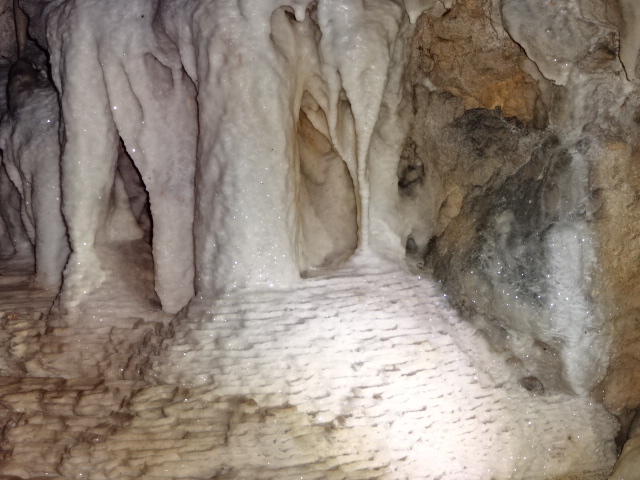
On a separate note, I have never encountered a cave that I didn’t love. During this period of self-isolation, I am reminded of a few of my visits to Mammoth Cave in Kentucky during a moment of my own armchair travel. This cave is known as the longest cave system in the world and is over four hundred miles long. At time of this writing, the cave is currently closed due to the covid epidemic but is normally open 364 days a year, closing only on Christmas. Normal hours are from 8:30 AM to 4:30 PM (Central Time) . Plan ahead before you go, as year round cave temperatures can be around 54 degrees Fahrenheit, so you likely might want a jacket. Reservations are strongly recommended, as cave tours often sell out in advance, but some self-guided walk up tickets are available at times. Ticket prices vary, depending on the tour you select, and there are many tour options to meet your needs. Some tours require passage through tight spots, and others do not. Other tours require long distances with hundreds of steps and steep inclines, yet others require limited steps through short distances. One way to experience something different might be the Violet City Lantern Tour, during which the only light for visitors is from lanterns. There is also an accessible tour for those with limited mobility as well.
It’s best to check the website below to plan your visit and to check on the status of any changes to park operations:

















 Carpe Diem with Caye